Case Study: How We Delivered a Complex Business Platform in Just 15 Days Without Compromising Quality
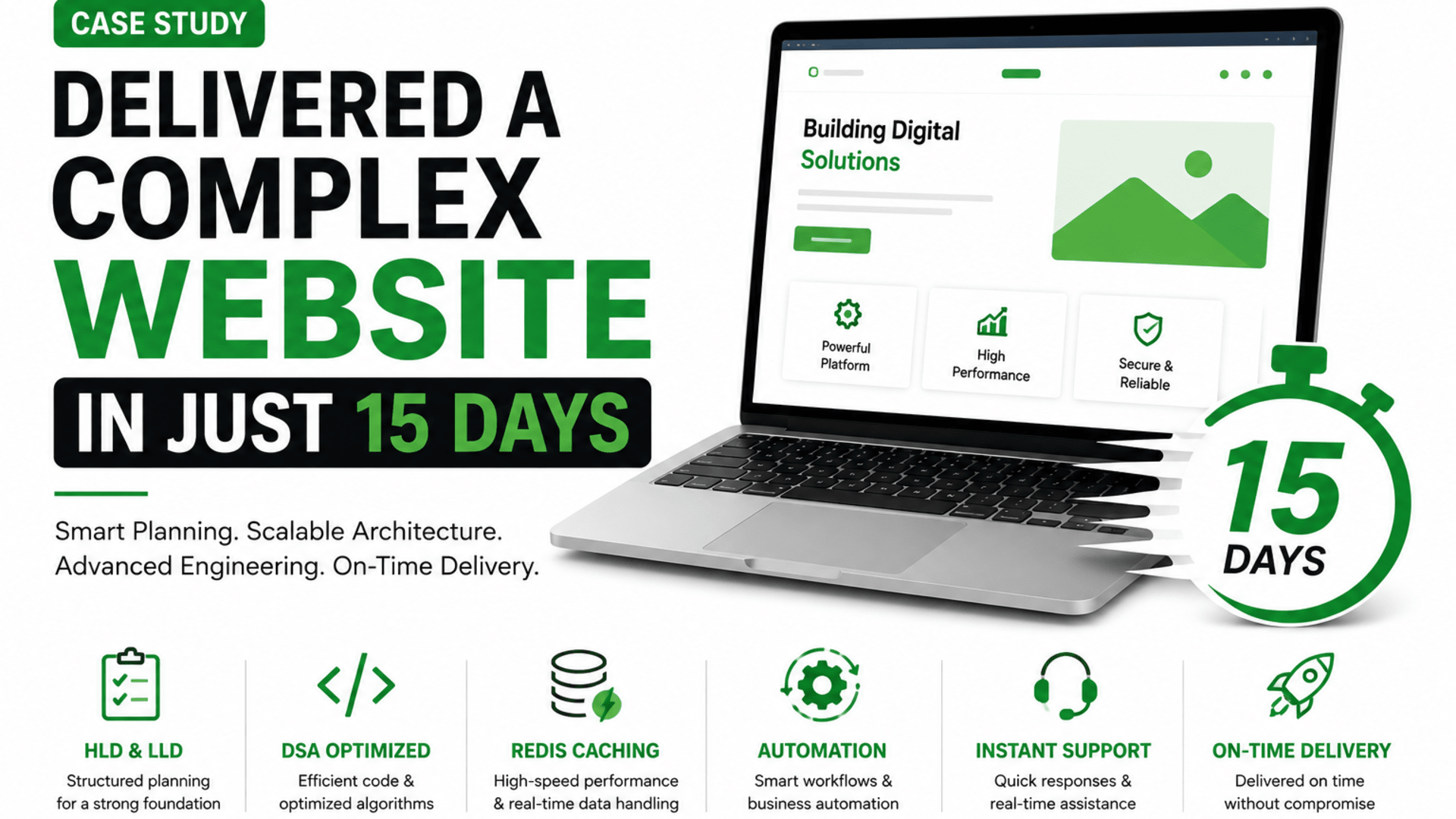
One of the biggest misconceptions in software development is that fast delivery means sacrificing quality. In reality, speed comes from planning, experience, and engineering discipline — not from skipping important steps.
Recently, our team was approached by a business that needed a complex web platform delivered within 15 days. The project included multiple user roles, API integrations, workflow automation, dashboards, real-time updates, admin controls, and a responsive user experience.
While many teams estimated several weeks or even months, we accepted the challenge with one condition:
“We would follow a structured software engineering process from day one.”
The result was a successful launch delivered on schedule with a scalable foundation ready for future growth. Here's exactly how we did it.
Understanding the Project Before Writing Code
Many development teams begin coding immediately. We don't. The first phase focused entirely on understanding the business. We worked closely with the client to identify:
- Business objectives & user journeys
- Core workflows & pain points
- Future scalability requirements
- Third-party integrations
- Security expectations
- Performance targets
High-Level Design (HLD): Building the Blueprint
Before implementation, we created a High-Level Design (HLD) to define the system architecture:
- Application architecture & frontend/backend separation
- API communication & authentication flow
- Database design & caching strategy
- Automation services & background workers
- Deployment architecture, monitoring and logging
Low-Level Design (LLD): Defining Every Component
Once the architecture was approved, we moved to Low-Level Design (LLD) — the implementation guide that ensured consistency across the project:
- Database schema & API endpoints
- Validation rules & error handling
- Service layer & business logic
- Component hierarchy & state management
- Access permissions
Applying Data Structures and Algorithms (DSA)
Efficient software is about more than functionality. We carefully selected data structures and algorithms to improve performance:
- Hash maps for fast lookups
- Queues for background processing
- Priority queues for task scheduling
- Trees for hierarchical navigation
- Optimized search, filtering & efficient pagination
- Smart caching strategies
Redis for High-Speed Performance
To keep the application responsive under load, we integrated Redis into the architecture — for session management, authentication caching, frequently accessed data, rate limiting, background job coordination, and temporary data storage.
This reduced database queries and improved the overall user experience.
Workflow Automation From Day One
Modern businesses expect software to automate repetitive tasks. Instead of relying on manual processes, we implemented automation for key workflows:
- Email notifications & status updates
- Scheduled jobs & data synchronization
- User onboarding
- Report generation & background processing
Modular Development for Parallel Progress
Rather than assigning one developer to the entire project, the system was divided into independent modules. Frontend, backend, APIs, automation, and quality assurance progressed simultaneously, allowing faster delivery without creating bottlenecks.
This modular approach also simplified testing and future enhancements.
Performance Optimization Before Launch
Performance wasn't left until the end. Throughout development we optimized database queries, API response times, image delivery, asset loading, lazy loading, code splitting, browser caching, and compression.
The goal: a platform that felt fast from the very first interaction.
Security Was Built Into Every Layer
Security is not a feature added after development — it is part of the architecture. Our implementation included secure authentication, role-based access control, input validation, API protection, secure password handling, HTTPS, error logging, and an audit-ready architecture.
Building security early reduced future maintenance and risk.
Continuous Testing and Quality Assurance
Every completed module was tested before integration — functional testing, API testing, cross-browser testing, mobile responsiveness, performance verification, and user acceptance testing.
Identifying issues early kept the project on schedule.
Instant Support Throughout Development
One factor our clients consistently appreciate is communication. During the entire project, we provided fast response times, daily progress updates, immediate issue resolution, transparent planning, and collaborative decision-making.
Rather than waiting days for answers, the client had direct access to our team whenever clarification or feedback was needed.
The Outcome
By combining structured planning with modern engineering practices, we delivered the platform within the agreed timeline while maintaining code quality, scalability, and performance.
Why Businesses Choose Fastest Creators
At Fastest Creators, we don't just build websites — we engineer digital platforms designed to grow with your business. Our development process includes:
Planning & Design
- Business Discovery
- High-Level Design (HLD)
- Low-Level Design (LLD)
- Scalable Architecture
Engineering
- Efficient DSA Implementation
- Redis Caching
- Workflow Automation
- API Integration
- Responsive UI/UX
Launch & Beyond
- Technical SEO
- Security Best Practices
- CI/CD Deployment
- Continuous Support
- Post-Launch Maintenance
Final Thoughts
A 15-day delivery isn't about working faster than everyone else — it's about eliminating uncertainty before development begins, making smart architectural decisions, and using proven engineering practices throughout the project.
When planning, design, implementation, testing, and communication work together, ambitious timelines become achievable without sacrificing reliability or scalability.
If you're looking for a development partner that values both speed and software quality, we'd love to help turn your next idea into a production-ready solution.
Ready for a website that actually generates sales?
Get a free website audit from our team — we'll show you exactly where your site is losing visitors and how to fix it.
Get a Free ConsultationTopics
Related Articles
View All
Recent Case Study: How Choosing the Right Tech Stack Saved Our Client Thousands
Four agencies, four completely different recommendations. Here's how we helped a client cut through the noise and pick the technology that actually fit — saving thousands in unnecessary development.
Read Article
Behind the Build: Four Complex Projects That Challenged Our Team and What We Learned
An AI sales platform, a fully automated operation, a secure healthcare system, and a 'simple redesign' that wasn't. Four real projects, the engineering behind them, and what each one taught us.
Read Article
Why Beautiful Websites Still Fail to Generate Sales (And What We Do Differently)
Your website looks professional, but the inquiries aren't coming in. After 8+ years and hundreds of projects, we can tell you: the problem usually isn't the design. Here's what actually makes a website sell.
Read Article