Behind the Build: Four Complex Projects That Challenged Our Team and What We Learned

One of the questions we're asked most often is:
“What's the most complex project you've worked on?”
The truth is, complexity isn't defined by the number of pages or the amount of code. A project becomes complex when it involves thousands of users, multiple systems, real-time communication, automation, security, integrations, and the flexibility to grow over time.
Over the past few years, we've worked on projects ranging from AI-powered SaaS platforms to enterprise business systems. Every project taught us something new, reinforced our engineering process, and reminded us that successful software starts with understanding the business — not just writing code.
Here are four projects that challenged our team and demonstrate how we approach modern software development.
1. Building an AI-Powered Sales Automation Platform
One client wanted to modernize their sales outreach by replacing multiple disconnected tools with a single intelligent platform. Instead of switching between email software, analytics dashboards, CRM tools, and automation platforms, they wanted everything managed from one place.
After analyzing their workflow, we designed a scalable SaaS architecture capable of handling campaign management, AI-generated content, automated follow-ups, provider management, analytics, and workflow automation.
To maintain performance while processing large amounts of data, we introduced Redis caching, background queue processing, and optimized API communication. The platform now handles complex automation reliably while remaining fast and scalable for future expansion.
2. Transforming Manual Business Operations Through AI Automation
Another client faced a different challenge. Their employees spent hours each day performing repetitive administrative work — customer notifications, report generation, workflow approvals, CRM updates, and document processing were slowing business growth.
Rather than adding more staff, the client wanted to automate as much of the operation as possible. We began by mapping every workflow, identifying repetitive tasks, and designing an automation strategy before development started.
The final platform included intelligent workflow automation, AI-assisted processes, scheduled background jobs, API integrations, role-based permissions, and centralized dashboards for monitoring operations.
The result wasn't just faster software — it fundamentally changed how the business operated every day.
3. Developing a Secure Healthcare Management Platform
Healthcare software presents unique challenges. Performance is important, but reliability, security, and data protection are even more critical.
The client required a complete digital platform where doctors, administrators, and patients could manage appointments, medical records, reports, notifications, and administrative tasks from one secure system.
Before writing code, our architects created detailed High-Level Design (HLD) and Low-Level Design (LLD) documents to ensure every workflow, permission, and integration was clearly defined.
Security was integrated throughout the application with secure authentication, encrypted communication, role-based access control, regular backups, and comprehensive validation. Performance optimization, responsive design, and continuous monitoring ensured the platform remained reliable under daily operational use.
4. Replacing a Traditional Website With a Scalable Business Platform
One of our most interesting projects began as what appeared to be a simple website redesign. During discovery, it quickly became clear that the client had outgrown their existing platform.
They needed advanced dashboards, business automation, custom workflows, API integrations, role-based permissions, analytics, and the flexibility to evolve into a SaaS platform in the future.
This wasn't a website problem — it was a software architecture problem.
Instead of recommending another CMS, we designed a fully custom solution using a scalable architecture. Redis caching reduced response times, background workers processed heavy operations efficiently, and modular development allowed future features to be added without rebuilding the application.
Most importantly, the client received a platform that could continue growing alongside their business rather than limiting it.
The Process Behind Every Successful Project
Although each project was different, our development process remained consistent:
- Business analysis first — before choosing any technology
- High-Level Design (HLD) & Low-Level Design (LLD) before implementation
- Database architecture, API planning & security strategy up front
- Clean architecture, modular code & performance optimization during development
- Redis, background workers, automation pipelines, AI integrations, cloud infrastructure & CI/CD where appropriate
- Ongoing support after launch: monitoring, maintenance, feature development & performance improvements
Choosing the Right Technology Is More Important Than Choosing the Newest One
One lesson every project has reinforced is that technology should always follow business requirements.
Some businesses genuinely benefit from WordPress because they need an easy-to-manage content website. Others are better served by Shopify because they need a secure and reliable eCommerce platform. Some startups benefit from no-code or low-code solutions that allow rapid validation.
For more complex requirements — such as AI automation, enterprise workflows, SaaS products, or high-performance business systems — a fully custom solution becomes the right investment.
Our role is never to recommend our favorite framework. Our responsibility is to recommend the technology that best supports the client's business goals, budget, timeline, and long-term growth.
Final Thoughts
Every successful project begins with a conversation — not about programming languages, but about business challenges. The code, architecture, automation, and infrastructure all exist to solve real problems and create measurable business value.
Whether we're building an AI-powered platform, automating internal operations, developing secure enterprise software, or modernizing an existing business system, our objective remains the same: build technology that helps businesses grow with confidence — not just software that works today.
Ready for a website that actually generates sales?
Get a free website audit from our team — we'll show you exactly where your site is losing visitors and how to fix it.
Get a Free ConsultationTopics
Related Articles
View All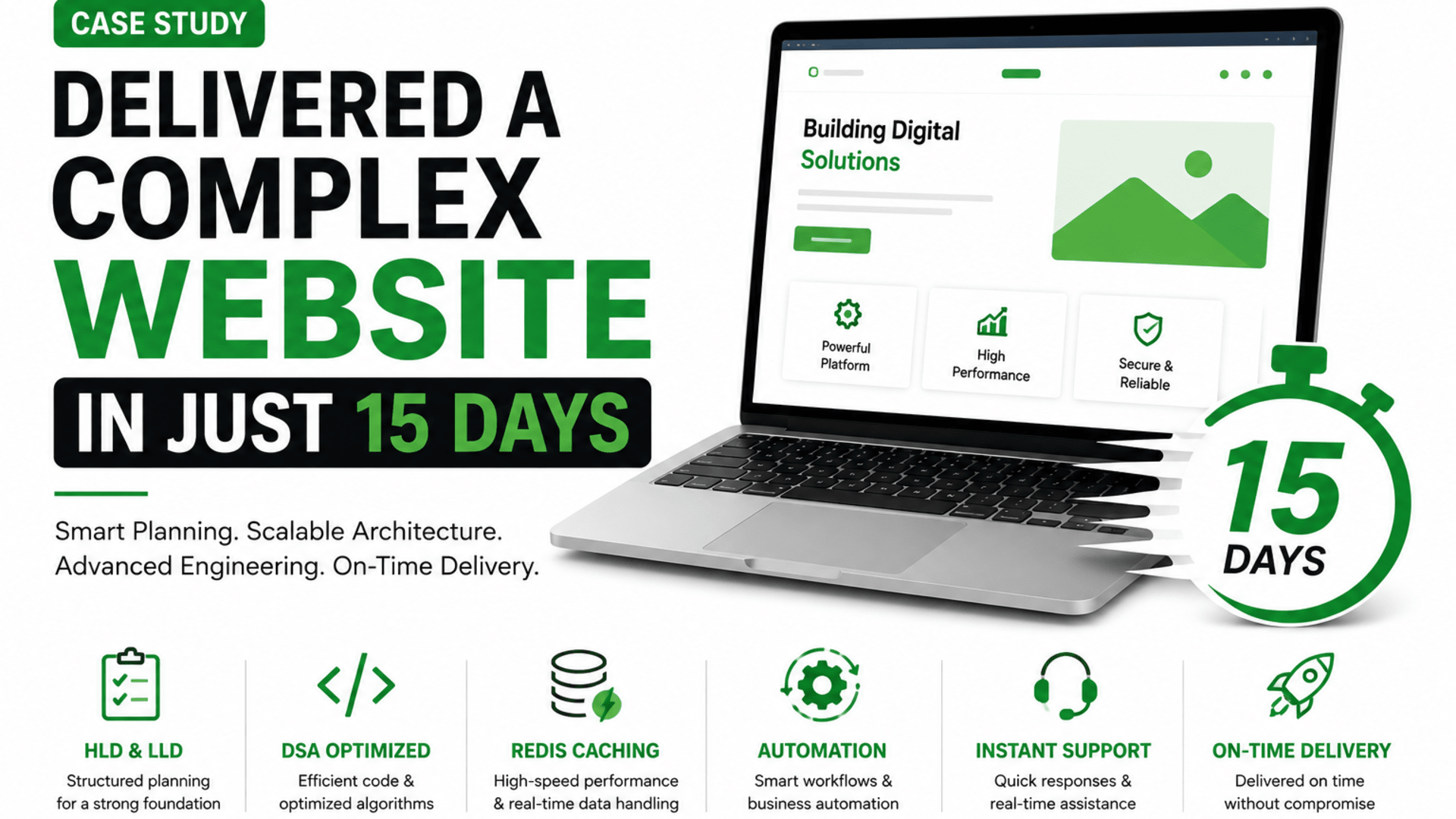
Case Study: How We Delivered a Complex Business Platform in Just 15 Days Without Compromising Quality
Fast delivery doesn't mean sacrificing quality. Here's the exact engineering process — HLD, LLD, DSA, Redis, automation, and parallel development — we used to ship a complex platform in 15 days.
Read Article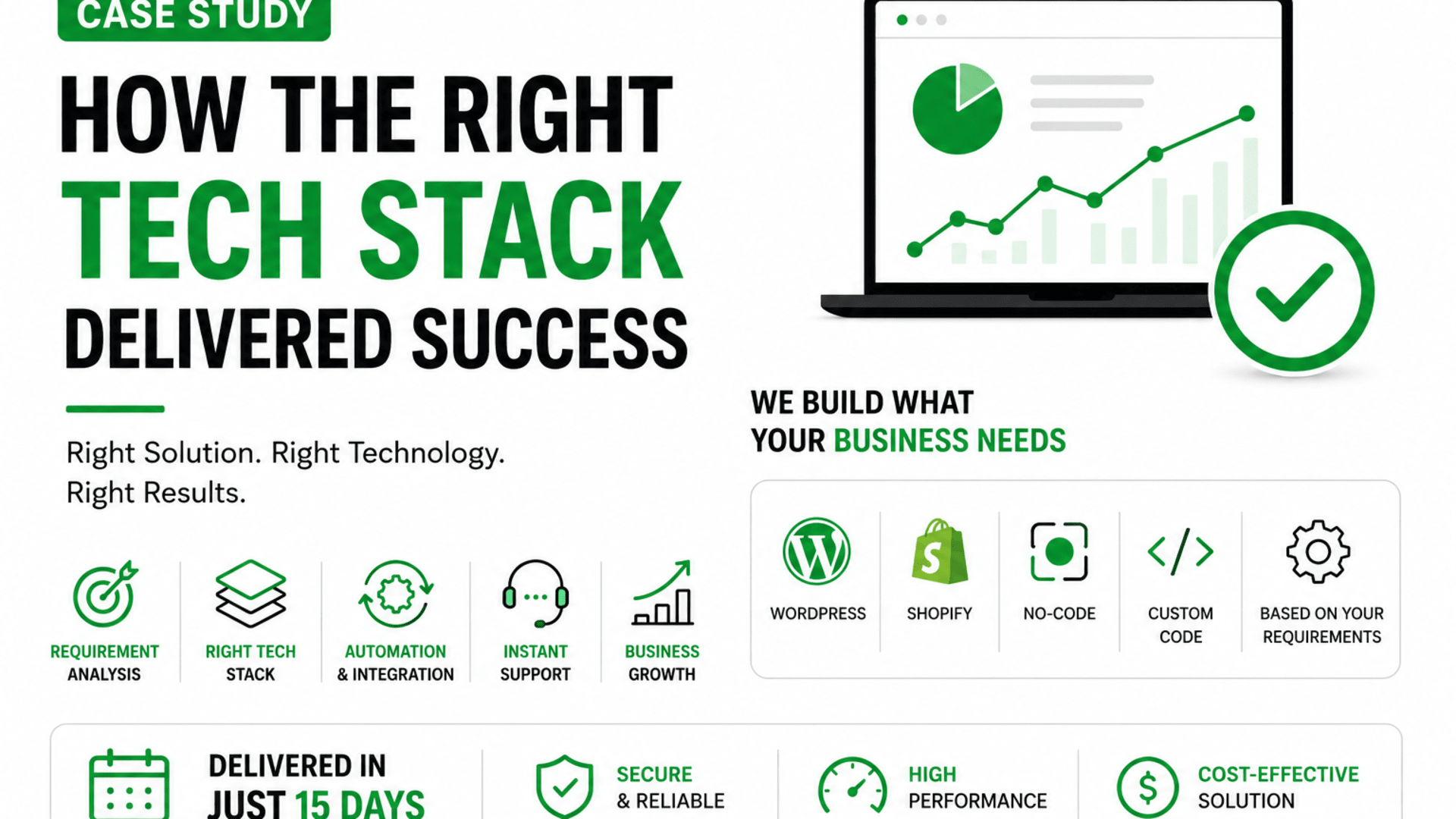
Recent Case Study: How Choosing the Right Tech Stack Saved Our Client Thousands
Four agencies, four completely different recommendations. Here's how we helped a client cut through the noise and pick the technology that actually fit — saving thousands in unnecessary development.
Read Article
Why Beautiful Websites Still Fail to Generate Sales (And What We Do Differently)
Your website looks professional, but the inquiries aren't coming in. After 8+ years and hundreds of projects, we can tell you: the problem usually isn't the design. Here's what actually makes a website sell.
Read Article